


C3 Blog
Dock Scheduling: How It Works and Why It Matters
August 4, 2023

Subscribe to the C3 Blog!
The latest industry news in your inbox.
The Author

 32 min


TL;DR
Dock scheduling is the process that ensures trucks arrive at the right dock, at the right time, and everything runs smoothly. It involves coordinating arrival times, managing loading and unloading, and preparing docks in advance for each shipment.
Key Takeaways
When trucks, teams, and timing all line up, everything else just works better. Dock scheduling helps warehouses move from reactive to proactive, replacing daily headaches with clear, calm coordination. That smoother coordination delivers real results:
- Keeps trucks moving: Less waiting at the gate means faster turnarounds and lower detention costs.
- Gives you visibility: Everyone, from warehouse staff to carriers, can see what’s happening in real time
- Helps you plan smarter: Use data to spot delays, track performance, and keep improving.
- Supports sustainability: Fewer idling trucks mean less fuel burned and cleaner air.
Introduction:
If you manage a warehouse or distribution center, you know what an unscheduled dock looks like. Trucks arrive without warning. Multiple carriers show up at the same time. A door sits empty for an hour, then three loads compete for the same dock at once. Your team spends the morning on the phone trying to figure out who is coming when.
Dock scheduling is the process of assigning structured time slots for carrier arrivals and departures at your facility’s loading docks. Instead of reacting to trucks as they show up, you operate from a shared appointment schedule that warehouse teams, carriers, and suppliers all work from in real time.
This guide covers what dock scheduling is, how the process works, what happens to operations without it, how it connects to yard management and which industries rely on it most. It also covers how shippers implement dock scheduling from initial configuration through go-live.
What Is Dock Scheduling?
Dock scheduling coordinates carrier arrivals, dock door assignments, and loading and unloading activity through a structured appointment system. It is sometimes called dock appointment scheduling or warehouse appointment scheduling. The underlying goal is the same across all these terms: replace manual, ad hoc coordination with a real-time schedule that everyone trusts and works from.
A proper dock scheduling process prevents double-bookings, distributes traffic across available dock capacity, and ensures the receiving team knows what is arriving before it arrives. The system handles the coordination that previously required constant phone and email exchanges between warehouse staff, carriers, dispatchers, and suppliers.For a fuller picture of how dock scheduling fits into broader operations, the connection between dock scheduling and end-to-end supply chain visibility is worth understanding alongside the scheduling mechanics themselves.
How Dock Scheduling Works
The process starts before a truck leaves its origin. When a carrier books an appointment, the key details are captured at that point: driver name, carrier, vehicle ID, expected cargo, and appointment window. By the time the truck arrives, the system already has everything it needs to process the visit efficiently.
On arrival, the driver’s details are matched against the appointment. Depending on the facility setup, this happens via ID scan, license plate recognition, a kiosk check-in, or a confirmation code. The outcome is straightforward: the appointment either checks out and access is granted, or a discrepancy is flagged for a supervisor to handle. No judgment calls based on who recognizes the driver.
Once cleared, the yard team receives an automatic update, the driver is directed to the assigned door, and the scheduling record is live for all parties. On departure, the same confirmation process runs in reverse, closing the appointment with timestamps that feed directly into performance reporting. The specific steps in a complete dock process are covered in detail in the FAQ section at the end of this article.
What Happens Without Dock Scheduling
Many facilities operate on a first-come, first-served basis. Trucks arrive, get in line, and wait for a door. At low volumes, this is manageable. As throughput grows, it breaks down in predictable ways.
Without structured scheduling, arrivals cluster. Early morning windows fill up because most carriers prefer them. Docks sit idle mid-afternoon. Drivers wait in the yard burning hours they could be on the road. The warehouse team has no ability to plan labor because they do not know what is coming until it arrives at the gate.
The real-world costs are documented. One large food distributor managing 115 trucks daily via spreadsheets juggled more than 300 calls and emails per day, with trucks constantly lining up, producing over $35,000 per month in driver detention fees. A U.S. Department of Transportation study found that manual scheduling processes increase truck wait times by 20 to 30 percent on average. A Canadian warehouse relying on email and printed spreadsheets spent four to five hours per week on appointment coordination alone, before any actual receiving work happened.
The costs also extend well beyond detention and overtime into places that rarely show up on a single line item:
- Lost sales when priority goods, such as weekly retail promotions or out-of-stock items, cannot be received in time.
- External storage fees, incurred periodically when you lack visibility into warehouse capacity relative to incoming volume.
- Inflated carrier rates and cost of goods sold, as carriers quietly price in the time they expect to waste at your facility.
These are not edge cases. They are the standard output of a high-volume dock running without a structured system
Warning Signs Your Dock Scheduling Isn’t Working
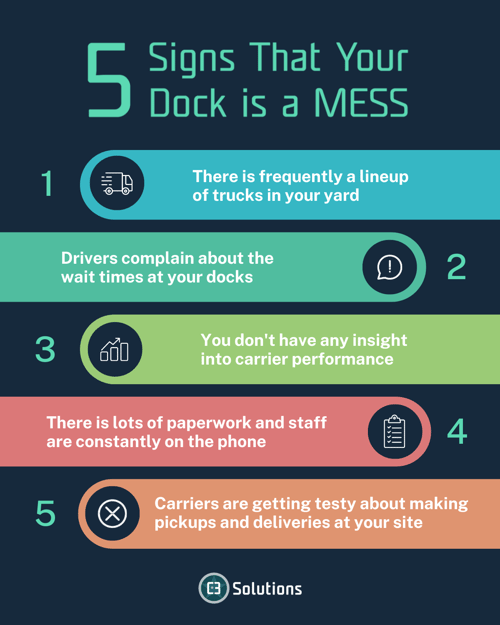
Most operators underestimate what disorganized dock scheduling actually costs them. If several of these patterns look familiar, the problem has likely outgrown your current process:
- Your best warehouse people are effectively running a call center. If skilled staff spend their day taking carrier calls, answering emails, and updating a shared spreadsheet, then fielding follow-up calls from purchasing checking on a key promotion, they are doing coordination work instead of the job you hired them for.
- Trucks regularly line up outside the gate. Whether it is carriers ignoring appointment times, drivers arriving without one, or a trailer that wasn’t loaded the way receiving needed, the result is congestion, detention charges, and sometimes friction with local authorities.
- Priority product is never available when you need it. Getting a promotional or high-priority load to the front of the queue takes last-minute schedule changes, extra calls, and dock overtime, every time.
- You’re paying avoidable overtime. When a load absolutely has to be received today, management approves the overtime, but everyone knows it traces back to uneven planning rather than genuine volume.
- Reporting eats days you don’t have. If measuring on-time delivery and vendor compliance takes the better part of a day each month, and the resulting numbers are incomplete enough for carriers and vendors to dispute, you cannot improve what you cannot reliably measure.
Why Dock Scheduling Matters
The operational case for structured dock scheduling shows up across five areas that directly affect cost, service quality, and carrier relationships.
- Faster truck turnarounds. Planned arrivals eliminate the gate queuing that inflates dwell time and triggers detention charges. When a dock door and a receiving team are ready when the truck arrives, the visit takes as long as it should and no longer.
- Labor planning accuracy. When you know exactly how many loads are arriving and when, staffing decisions become data-driven rather than intuitive. No more overstaffing in the morning just in case, and no scrambling to find extra hands when an unexpected wave of trucks arrives at shift end.
- Visibility for all parties. A centralized schedule gives warehouse supervisors, carriers, suppliers, and customer service teams a shared view of what is happening and when. The constant inbound calls asking for arrival updates stop when the information is already visible to everyone who needs it. This connects directly to broader supply chain visibility goals.
- Carrier relationship quality. Carriers prefer facilities that are organized and predictable. A dock that gets trucks in and out on schedule, without long waits, makes your facility easier to work with. That matters when carriers are choosing which loads to prioritize during tight capacity periods.
- Sustainability impact. Fewer trucks idling in the yard means less fuel burned and lower CO2 output from your logistics operation. For facilities with formal sustainability commitments, dock scheduling provides a concrete, measurable contribution to emissions reduction targets. In regions with strict emissions regulations, reducing truck queuing also supports regulatory compliance.
How Dock Scheduling Connects to Yard Management
Dock scheduling does not operate in isolation. It is one part of a coordinated workflow that includes gate operations, yard management, and documentation. When dock scheduling is connected to a yard management system, the entire inbound and outbound flow becomes coordinated rather than sequential.
The YMS knows a truck is arriving because the dock schedule says so. The gate validates the driver against the appointment. The dock assignment is communicated automatically. When the load is complete, departure is confirmed and the record closes. Without that connection, dock scheduling solves the “when” but not the “how”, the gate, yard, and dock continue operating independently even if each individual step is scheduled.This is where the real efficiency gains live.
Dock scheduling that shares data bidirectionally with yard management eliminates the handoff gaps where trucks wait not because a door is unavailable, but because no one has connected the arrival data to the yard team that needs to act on it. For operations evaluating both systems together, integrating yard management with warehouse and transportation systems is the foundation that makes the coordination work.
Industries that rely on dock scheduling
Dock scheduling is used wherever high volumes of inbound or outbound freight require structured coordination. The requirements vary significantly by industry.
Grocery
Grocery scheduling is among the most complex in any sector. The volume of exceptions, PO-level rules, and freshness constraints that govern booking decisions means a generic scheduling platform reaches its limits quickly. Grocers, wholesalers, and retailers at every scale face the same core questions: Is the product arriving fresh? Are vendors delivering the right items on time? Are dock resources being used efficiently?
A purpose-built solution applies unload duration rules, PO constraints, and SKU and quantity data to ensure the right product arrives at the right time while balancing the dock workload across the day. Omnichannel grocery operations add another layer of complexity, with inbound schedules that must account for both store replenishment and direct-to-consumer fulfillment from the same facility.Explore C3 Solutions’ F.O.O.D. Program, designed specifically for the grocery industry.

Retail
Retailers were early adopters of dock appointment scheduling, but many have not modernized their process in decades. Replacing phone calls with emails and paper calendars with spreadsheets is not modernization. It is the same manual process in a different format. Retail operations that have moved to purpose-built scheduling report measurable reductions in scheduling labor, better KPI visibility, and more reliable on-time arrival and unload duration reporting. Visit C3 Solutions’ retail program page to see how modern dock scheduling is reshaping retail receiving operations.
Transportation and Logistics
Third-party logistics providers operate on thin margins and are accountable to multiple clients simultaneously. Eliminating driver wait times, maximizing labor utilization, and demonstrating compliance through KPI reporting are the primary reasons 3PLs invest in carrier appointment scheduling. The ability to show each client their own scheduling performance data, separately, is a feature that generic tools do not support well.
Manufacturing
Just-in-time manufacturing operates with no tolerance for late or out-of-sequence deliveries. Dock appointment scheduling gives manufacturing sites visibility into each DC’s inbound schedule and the means to communicate appointment times directly to carriers. When trucks arrive on time and in the right sequence, congestion drops and production flow holds.
What Are Best Practices for Efficient Dock Scheduling?
Effective dock scheduling starts with a plan, not a calendar. Any experienced scheduler already spreads deliveries and pickups by order type, product type, and loading or unloading complexity, and treats LTL, FTL, containers, and rail cars differently.
A dock schedule is not a generic calendar where you book an open slot; it has multiple dimensions. Some sites simply need loads spread evenly across the day; others must cap container loads per period or limit specific products, such as water, paper, or cosmetics, within a given window. The practical first step is to list every factor and variable that influences truck turnaround time, then choose a system that can accommodate them.
Managing delivery windows deserves special attention. A retailer might offer suppliers a broad six-hour delivery window, which makes sense for guaranteeing same-day store replenishment but creates punishing receiving peaks, driver waits, and overtime at the dock. A capable system reconciles both goals: it honors the expected delivery date while prioritizing appointment times using PO and appointmen
To get the most out of dock scheduling (and avoid reverting to old bottlenecks), consider these best practices and tips used by industry leaders:
| Best practice | What It Does in Practice |
| Forecast and plan for demand | Use historical volume data to anticipate busy periods and open additional slots or extend hours in advance rather than reacting when congestion arrives. |
| Enable carrier self-service | Give carriers direct portal access to book their own appointments. This eliminates the coordination overhead your team absorbs when managing every appointment manually. |
| Enforce appointment commitments | Treat appointment times as a two-way commitment. Trucks arriving hours early or late without consequence undermine the schedule for every other carrier that day. |
| Build in buffer time | If most unloads take one hour, schedule doors one hour and fifteen minutes apart. That buffer absorbs minor overruns without cascading into the next appointment slot. |
| Automate recurring appointments | Daily milk runs and standing weekly pickups should be automated rather than manually rebooked. This removes scheduling labor and eliminates missed standing appointments. |
| Categorize and color-code appointments | Visual differentiation between inbound, outbound, and transfer appointments speeds up planning and reduces door assignment errors during busy periods. |
| Integrate with yard management and gate check-in | Use the same appointment data at the gate to streamline driver check-in and yard assignment. Connecting yard management and dock scheduling on a shared data layer eliminates the gaps where information gets lost between systems. |
| Measure and improve continuously | Review dock KPIs including dwell time, on-time arrival rate, and reschedule frequency on a regular cadence. The scheduling data is your improvement roadmap. |
What Is the Best Dock Scheduling Configuration?
The best dock scheduling configuration for a given operation depends on volume, facility complexity, integration requirements, and industry-specific rules. Across those variables, the criteria that consistently separate purpose-built platforms from generic scheduling platforms are:
Carrier self-service portal. The biggest labor reduction in any dock scheduling implementation comes from letting carriers book their own appointments. If your team still manually creates every appointment, you have digitized the spreadsheet without eliminating the work. The portal needs to be simple enough for any carrier dispatcher to use without training.
Rule-based scheduling logic. The system should enforce your constraints automatically: which doors accept which load types, how long each appointment window should be, time restrictions by carrier tier, and facility-specific cutoffs. The more the system enforces rules without manual intervention, the less your team has to manage by exception.
Real-time visibility for all parties. Warehouse staff, carriers, and supervisors each need a live view relevant to their role. A schedule that one party can see and another cannot recreates the information asymmetry that dock scheduling is meant to eliminate. This connects directly to continuous decision-making across the supply chain.
Integration with yard management and TMS. Dock scheduling that operates in isolation from yard management and transportation management creates handoff gaps. The best platforms share appointment data bidirectionally with adjacent systems so that a confirmed appointment at the dock is immediately visible in the yard and the TMS without manual re-entry.
KPI reporting and analytics. Dwell time, on-time arrival rate, door utilization, and exception frequency should be measurable and exportable. The data your system captures is also how you demonstrate ROI to stakeholders. The dock scheduling business case depends on having those numbers.
Scalability and multi-site support. Operations with more than one facility need a platform that manages multiple sites under a single login with site-specific configurations rather than separate instances.

What Is a Dock Scheduling API?
For operations integrating dock scheduling into an existing technology stack, the API capability of the scheduling platform matters as much as its front-end features. A dock scheduling API allows external systems (TMS platforms, WMS tools, ERPs, and carrier portals) to exchange appointment data automatically without manual re-entry.
The criteria that distinguish a strong dock scheduling API:
- Bidirectional data exchange. The API should both receive appointment requests from external systems and push status updates back out. One-way integrations create the same data lag that dock scheduling is meant to eliminate.
- Standard integration protocols. RESTful APIs with clear documentation reduce development time. Proprietary or poorly documented APIs become integration debt that compounds with every system update.
- Real-time event triggers. When a carrier checks in, a dock is assigned, or an appointment is modified, those events should be available as API triggers so connected systems update immediately.
- Pre-built carrier connectivity. Platforms with EDI support or pre-built connectors for common carrier systems reduce the custom development required to bring carrier data into the scheduling platform.
- Versioned documentation and support. API quality is only as reliable as the documentation and support behind it. Version-controlled documentation and active developer support are significantly easier to work with during implementation and after system updates.
For operations scoping a broader logistics system integration, dock scheduling API requirements should be evaluated alongside yard management and TMS integration requirements. The three systems deliver the most value when they share data through a common integration layer rather than point-to-point connections.
How Shippers Implement Dock Scheduling
Implementation is not just a solution configuration. It involves carrier communication, process redesign, and team training. The typical sequence:
- Document scheduling rules and constraints. Before configuring the system, map out how your docks actually operate: which door handles which load type, available time windows by carrier tier, unload duration by product category. These rules become the scheduling logic the system enforces automatically.
- Configure the carrier portal. Set up the self-service booking interface that carriers will use, including time slot structures, carrier access permissions, appointment request workflows, and automated confirmation notifications.
- Communicate the change to carriers. Carrier adoption is the most common implementation challenge. Carriers accustomed to calling or emailing need clear instructions, a transition timeline, and a support contact during the first few weeks. The relationship implications of moving to appointment scheduling are worth addressing directly with key carriers before go-live.
- Train internal teams by role. Dock managers, receiving supervisors, and gate staff each interact with the system differently. Role-specific training reduces the workarounds that undermine adoption after launch.
- Integrate with existing systems. Connect the dock scheduling platform to your WMS, TMS, and yard management system so that appointment data flows automatically across platforms.
- Monitor and refine. The first 30 to 60 days reveal where scheduling rules need adjustment: slots that consistently overrun, carrier no-show patterns, door assignments that create yard congestion. Treat the initial configuration as a starting point, not a finished product.
Before you begin, it helps to take inventory of a few diagnostic questions: What factors influence your dock operations, and which should be part of the plan?
- What constraints and rules apply to those factors?
- Who, internally and across your supply chain, needs visibility on dock operations?
- What are your receiving and shipping priorities?
- Which systems should the platform exchange data with?
- And which reports and dashboards will you need to measure productivity and KPIs? Answering these upfront makes every later step faster.
Why Measurement Alone Often Justifies the Investment
One reason companies adopt dock scheduling is easy to overlook: many operations, including large ones with hundreds of millions in sales, simply cannot produce reliable numbers on their own dock activity. How many trucks arrived? How long did unloading take, and who did it? How many minutes do schedulers spend on the phone booking appointments, and what share of internal calls come from buyers chasing status?
In practice, the primary motivation to adopt a system is frequently not the efficiency gain at all, it is the ability to measure current activity in the first place, so that decisions rest on data rather than hearsay. As distribution centers move faster than ever, with promotions that once took months now planned in weeks, the inability to pull a simple activity report with measurable KPIs becomes a real constraint on decision-making. Reliable measurement then becomes the foundation for every continuous-improvement effort that follows.
Dock Scheduling and Sustainability
The environmental impact of unscheduled dock operations is significant and often underestimated. A truck waiting two or more hours to be loaded is burning fuel with no productive output. Across dozens of trucks per day, the cumulative CO2 is material. Structured dock scheduling reduces total idle time by ensuring trucks are processed on schedule rather than queuing at the gate.
For operations with formal sustainability commitments, dock scheduling provides a concrete, measurable step toward carbon reduction targets. In regions with emissions regulations, including parts of the EU and California, reducing truck queuing also supports regulatory compliance. Beyond the environmental dimension, reducing wasted time and fuel makes logistics more cost-efficient and operationally resilient — which is the practical foundation of sustainable operations.
Current Trends: AI and the Future of Dock Scheduling
Dock scheduling is not a static topic, new technologies and business priorities are continually reshaping how companies manage appointments. Here are some key trends (especially in the US, Canada, UK, Europe, and Australia) that are currently influencing dock scheduling and related logistics processes:
Market momentum. The dock scheduling software market is on a steep growth curve, projected to grow at roughly an 11 percent annual rate through the end of the decade and approaching an estimated US$10 billion by 2029, with the U.S. representing close to a third of the global market. That trajectory is increasingly tied to AI.
Full automation of the scheduling lifecycle. Modern dock scheduling has moved well past appointment booking. Leading platforms now automate carrier notifications, exception handling, no-show management, and capacity rebalancing when the schedule shifts during the day.
Dynamic scheduling driven by real-time data. GPS from trucks, live traffic feeds, and IoT sensors at gates are enabling scheduling systems to adjust appointments automatically rather than waiting for a manual update. A truck running two hours late no longer requires a phone call to the dock supervisor; the system re-sequences the day’s appointments without human intervention.
Where AI is actually changing dock scheduling. Rule-based scheduling is giving way to systems that learn and adapt:
- Predictive scheduling. AI models forecast peak periods and likely delays, then distribute docking times automatically so capacity is used evenly across the day, reducing the manual configuration that consumes a dock manager’s time.
- Vision-based check-in and monitoring. AI with text recognition can read truck license plates on arrival and route drivers to the correct dock. Camera feeds linked to AI can watch dock activity, flag anomalies such as 30 minutes with no movement, and alert staff so drivers leave on schedule.
- Autonomous vehicle and yard integration. As self-driving trucks and automated yard trucks and AS/RS come online, AI-enabled scheduling can communicate directly with these systems to set arrival times and loading areas with no human input.
- Real-time, multi-source adjustment. By continuously reading traffic, weather, and operational capacity, AI re-optimizes the day’s schedule around unexpected delays, reducing downtime and improving flexibility.
Carrier self-service as a baseline expectation. Self-service scheduling portals for carriers and suppliers have moved from a premium differentiator to a standard expectation. Facilities that still manage all appointments internally are increasingly at a service disadvantage when carriers choose between facilities offering comparable rates.
What to plan for before adopting AI. The gains come with real prerequisites: securing the data these systems collect and analyze; integrating AI with existing ERP, WMS, and TMS rather than bolting it on in isolation; and managing adoption through staff training and a deliberate cultural shift, ideally building some capability in-house to keep the systems well-managed and costs in check.
In essence, dock scheduling is evolving to be smarter, more interconnected, and more user-friendly. Operations in the US, Canada, UK, EU, Australia and beyond are rapidly adopting these modern practices.
To explore how C3 Reservations handles dock scheduling for your operation, request a demo or browse the C3 resource center for case studies, white papers, and industry-specific guides.

FAQ:
Dock scheduling is the process of assigning structured time slots for carrier arrivals and departures at a facility’s loading docks. It coordinates inbound and outbound truck activity through a shared appointment system, replacing unstructured first-come, first-served arrivals with a managed schedule that warehouse teams, carriers, and suppliers all work from in real time. The result is reduced wait times, more predictable labor demand, and fewer detention fees.
Dock appointment scheduling is the specific process of creating and managing time-based appointments for carrier arrivals and departures. It involves configuring scheduling rules by door type, load category, and carrier tier, then providing carriers and suppliers with a self-service portal to book and manage their own appointments. The outcome is a live schedule with automated confirmations and notifications that eliminate the manual coordination overhead of phone and email-based systems.
The dock is the physical interface between a facility’s internal operations and the transportation network. Inbound freight arrives through the dock; outbound shipments depart through it. If dock operations are congested, disorganized, or running without structured scheduling, that inefficiency propagates both upstream to carriers and downstream into warehouse operations and order fulfillment. The dock is not a back-of-house detail, it is where supply chain plans are tested against physical reality.
Here’s a typical process broken down:
1- Appointment creation. A carrier or supplier books a slot (or is assigned one) for arrival or pickup through the self-service portal or by coordination with the operations team.
2- Pre-arrival preparation. The carrier submits trailer type, PO numbers, and load description. The scheduling system validates door availability, required resources, and buffer time.
3- Check-in. On arrival, the driver confirms the appointment via kiosk, portal, or gate check-in. The system validates the visit against the scheduled appointment.
4- Dock assignment. The system or planner assigns a door based on load type, priority, and available labor and equipment.
5- Loading or unloading. Freight is processed according to the scheduled plan.
6- Check-out and departure. The visit is closed, timestamps are captured, and performance data is logged automatically.
7- Post-analysis. Dwell time, arrival accuracy, and exception data are reviewed to refine slot durations and scheduling rules for the next period.
A dock manager oversees the day-to-day execution of dock scheduling and receiving operations. Core responsibilities include monitoring upcoming appointments and identifying conflicts before they affect operations, resolving last-minute exceptions without disrupting the rest of the schedule, allocating doors and labor, communicating with carriers and internal teams on changes, and reviewing KPI data to drive continuous improvement. With a well-configured scheduling system in place, the dock manager’s role shifts from reactive problem-solving to proactive flow management.
A dock scheduling API is the integration layer that allows a dock scheduling platform to exchange appointment data automatically with external systems such as a TMS, WMS, or ERP. A strong API supports bidirectional data exchange, real-time event triggers, and standard integration protocols that reduce custom development requirements. For operations building a connected logistics technology stack, dock scheduling API capability should be evaluated alongside yard management and TMS integration requirements.
Shippers implement dock scheduling solutions by first documenting scheduling rules and constraints, then configuring the carrier portal, communicating the change to carriers, training internal teams by role, and integrating the scheduling platform with their WMS, TMS, and yard management system. The first 30 to 60 days of live operation typically require rule refinement based on real scheduling data. The dock scheduling business case guide covers how to scope and justify the investment before beginning implementation.
Other articles you might like
-

Self-Service Dock Scheduling: What It Looks Like for Drivers and Dispatchers
By Greg Braun • July 21, 2026A dispatcher needs to book a dock appointment at a DC in New Jersey. She calls and is put on… -

C3 Solutions at Warehouse. & Yard. 2026: What We Saw, Heard, and Learned
By Greg Braun • July 7, 2026Trade shows come and go. But every so often, one captures exactly where the industry is heading—and Warehouse. & Yard…. -
Best Warehouse Automation Tools for Load Planning
By Annie Ngo • June 18, 2026Warehouse teams have a lot on their plates. One of the biggest tasks is moving inventory. With the e-commerce boom…
Leave a comment