


C3 Blog
Time Slot Management: The Key to Reducing Wait Times
April 7, 2026

Subscribe to the C3 Blog!
The latest industry news in your inbox.
The Author

 19 min


Monday morning at a busy warehouse yard. Trucks are lined up outside the facility. Drivers are waiting. The dock team is scrambling to figure out who is arriving when, which door is available, and whether the labor is in place to handle what just showed up unannounced.
The result is delays, congestion, and inefficiencies that ripple through the rest of the day’s operations.
This environment is familiar to any operation running without structured time slot management. Trucks arrive randomly, dock doors fill up without coordination, and the inefficiency compounds across every shift.
Without a defined system, the results are predictable: bottlenecks at the gate, lost labor hours, mounting demurrage charges, and missed delivery deadlines. It does not need to be this way.
A time slot management system gives warehouse teams the ability to allocate specific delivery and pickup times for trucks to arrive and notify carriers automatically when schedules change.
The outcome is a more predictable operation: drivers know when they will be received, wait times drop, dock coordination improves, and the warehouse team works from a plan rather than reacting to what just pulled into the yard.
This article covers what warehouse time slot management is, why wait times matter, the key benefits of implementing a system, common challenges, and how to evaluate time slot management software for your operation..
What is Time Slot Management?
Time slot management controls the allocation of specific arrival and departure windows for inbound and outbound trucks at a warehouse or distribution center. By proactively managing carrier and truck time slots, companies achieve smoother traffic flow, reducing congestion and delays. This enables structured scheduling with optimized dock utilization, easier yard management, and overall better warehouse management.
A useful parallel: a restaurant that does not take reservations fills up unpredictably, with some periods overwhelmed and others near-empty. By managing arrival timing, restaurants maintain a steady, manageable flow. Time slot management does the same for truck arrivals, spreading load across available capacity rather than absorbing whatever shows up when it shows up.
In supply chain operations, warehouse time slot management eliminates bottlenecks, reduces truck turnaround time, and simplifies loading and unloading procedures by ensuring the right resources are in place when each truck arrives.
But what happens when things don’t go as planned, like late carrier arrivals?
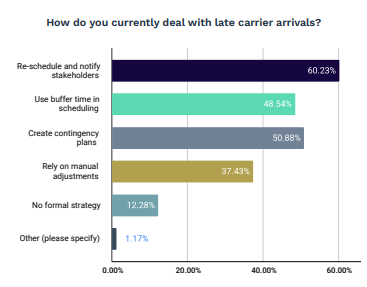
According to our survey, over 60% of companies re-schedule and notify stakeholders when a truck is running behind, while more than half create contingency plans or add buffer time to their schedules. Surprisingly, 37% still rely on manual adjustments, and over 12% admit they don’t have any formal strategy at all.
That data reflects how many operations are still reactive rather than structured. Without a defined time slot management system, disruptions do not stay contained. They ripple through the rest of the day’s schedule.
Why Wait Times Matter
Long wait times are not just an inconvenience. They affect four operational areas with measurable cost consequences:
- Driver satisfaction. Extended delays mean lost hours for drivers, which affects morale, retention, and a carrier’s willingness to prioritize your facility when capacity is tight.
- Carrier relationships. Repeated delays erode trust with logistics partners. Over time, facilities with poor scheduling reputations get deprioritized when carriers have choices.
- Labor costs. Unscheduled arrivals create labor mismatches: idle dock workers during slow periods and unplanned overtime when trucks cluster at shift end.
- Facility congestion. Uncoordinated arrivals turn the yard into a queuing zone. That congestion affects not just the trucks waiting but every process dependent on dock availability.
The compounding effect of these four factors is what makes wait time reduction one of the highest-return investments a warehouse operation can make.
Benefits of Time Slot Management
A time slot management system shifts warehouse operations from reactive to proactive. Instead of absorbing last-minute surprises, the team works from a structured schedule built around actual capacity. The benefits show up across six operational areas.
Reduces Congestion and Idling
Unscheduled truck arrivals often lead to congestion at gates and docks, causing long lines and unnecessary engine idling. A time slot management system distributes truck arrivals evenly across the day, significantly reducing traffic build-up and overcrowded yards.
This not only improves flow and safety but also minimizes fuel waste and carbon emissions. For companies focused on sustainability, it’s a win-win: fewer delays and a smaller environmental footprint.
Improves Dock Efficiency
When you know who’s arriving and when, your warehouse team can prepare accordingly. Time Slot Management supports better labor allocation, faster staging, and shorter turnaround times.
With less scrambling and more structured planning, docks process more loads in less time using the same resources. Throughput increases without adding headcount or extending hours.
Boosts Carrier Experience
Carriers and drivers value predictability. Time Slot Management gives them the ability to plan their routes with confidence, knowing exactly when they’ll be received at your facility.
This reduces driver frustration, helps maintain their schedules, and makes your site more carrier-friendly. Carriers that experience consistent, on-schedule processing are more likely to prioritize your facility, which matters most when capacity is tight and they are choosing between loads.
Allows Data-Driven Planning
Every scheduled time slot generates data that can be analyzed to identify patterns and inefficiencies. With the right tools, you can track no-show rates, delayed arrivals, average dwell times, and peak usage windows.
These insights enable you to optimize operations: adjust staffing levels, prevent overloads, and improve carrier performance. Time slot management software generates this data automatically, turning scheduling records into an ongoing source of operational intelligence.
Minimizes Detention Fees
When schedules run late, detention fees pile up, hurting both shippers and carriers. With Time Slot Management, you can dramatically reduce truck wait times and keep your operations flowing on time.
The result is lower detention costs, fewer billing disputes, and better compliance with service level agreements (SLAs). For operations where detention fees are a recurring cost, structured time slot scheduling is often the most direct lever available.
Enhances Stakeholder Collaboration
Time Slot Management creates a shared platform for communication between shippers, carriers, warehouse teams, and suppliers. Everyone works from a centralized schedule, reducing miscommunication and manual coordination overhead.
By giving all parties access to the same schedule, a time slot management system reduces the calls and emails that exist only because one party does not know what another already knows. Handoffs become cleaner at every stage of the logistics process.

Time Slot Capacity Management
One of the most important and least discussed aspects of time slot management is capacity management: ensuring that the number of scheduled slots does not exceed what the dock, labor, and yard can actually handle.
Time slot capacity management involves setting the upper limits on how many trucks can be scheduled in a given window, by door type, by shift, and by load category. Without capacity rules built into the scheduling system, it is possible to have a fully booked schedule that is still unworkable — every slot is filled, but the dock cannot process them all on time, and wait times build despite the appointments being in place.
Effective time slot capacity management requires understanding three variables:
- Door availability. Not all dock doors handle all load types. A door designated for refrigerated loads cannot be reassigned to a dry freight trailer mid-shift without disrupting the receiving process. Capacity rules by door type prevent these conflicts from being scheduled in the first place.
- Labor capacity. A schedule can have ten trucks arriving in the first two hours of the shift, but if the receiving team can only process five per hour, the other five will wait regardless of their appointment times. Slot capacity should reflect the actual labor available, not just the number of physical doors.
- Yard space. Inbound trailers that arrive on time but cannot immediately access a dock door need somewhere to stage. If yard capacity is not factored into the scheduling logic, on-time arrivals create congestion rather than preventing it.
Purpose-built time slot management software handles capacity constraints automatically: it prevents overbooking by enforcing the limits you set, flags appointments that would exceed capacity thresholds, and rebalances the schedule when cancellations or no-shows create available space. Manual scheduling tools, including spreadsheets, have no mechanism to enforce these constraints, which is why overbooking is one of the most common failure points in facilities that have not yet adopted a dedicated system.
Challenges in Implementing Time Slot Management
Implementing a time slot management system comes with predictable challenges. None of them is insurmountable, but each is worth addressing before go-live rather than after.
Resistance to Change
Teams and carriers accustomed to calling in or emailing appointments may push back on a structured system because it reduces their flexibility. Effective change management means explaining the long-term benefits early and involving key stakeholders in the configuration process rather than rolling out a finished system and expecting immediate adoption.
System Integration
Connecting a new time slot management system with existing WMS, TMS, and yard management platforms requires upfront technical planning. Compatibility between systems determines whether appointment data flows automatically or requires manual reconciliation, the latter defeats much of the efficiency the system is meant to deliver.
Data Accuracy
Time slot management software is only as reliable as the data feeding it. Inaccurate carrier details, incorrect load descriptions, or outdated PO information produce scheduling errors that erode trust in the system quickly. Establishing data standards before go-live is easier than rebuilding trust after a rocky launch.
Scalability
A system that handles current volumes adequately may not scale as throughput grows. When evaluating time slot management software, assess it against projected volume and facility complexity, not just current state. A platform that requires a re-implementation at double the current volume is not a scalable solution.
Compliance and Standardization
Multi-site operations and cross-border supply chains introduce compliance requirements that vary by region and partner. A time slot management system needs to accommodate location-specific rules without requiring separate configurations that cannot be managed from a central view.
The challenges can vary depending on the region, nature of the business, and more. For example, in cold chain logistics, fresh produce, or highly seasonal supply chains, the main challenge is minimizing waste. However, with the right partner, a purpose-built system handles these constraints as part of its standard configuration.

What to Look for in Time Slot Management Software
Not all time slot management software is built the same way. Generic scheduling tools and purpose-built dock scheduling platforms handle time slot management differently, and the gap between them shows up in high-volume operations where rule enforcement, carrier self-service, and real-time visibility matter most.
When evaluating time slot management software for a warehouse or distribution center, the features that separate capable platforms from basic scheduling tools are:
- Carrier self-service portal. Carriers and suppliers should be able to book, modify, and cancel appointments without requiring your scheduling team to manage each one manually. Self-service is the single biggest driver of labor reduction in any time slot management implementation.
- Capacity enforcement. The software should prevent overbooking automatically by enforcing the capacity limits you set by door, shift, and load type. A system that allows manual overrides without flagging capacity conflicts transfers the overbooking problem from a paper process to a digital one.
- Real-time visibility. All parties (warehouse supervisors, dock staff, carriers, and yard teams) should have role-appropriate visibility into the live schedule. When one party is working from a different version of the schedule than another, the coordination failures that time slot management is meant to prevent reappear.
- Integration with yard management and WMS. A time slot management system that operates independently from the yard management system and warehouse management platform creates data silos. The most effective implementations share appointment data automatically across all three systems.
- Automated notifications. Carriers should receive automatic confirmations, reminders, and change notifications without requiring your team to send them manually. This eliminates the communication overhead that consumes scheduling team hours in manual operations.
- Reporting and analytics. Dwell time, on-time arrival rate, no-show frequency, and peak capacity usage should be measurable and reportable. The KPIs your time slot management software tracks are what enable continuous improvement rather than just scheduling maintenance.
How to Implement a Time Slot Management System
Implementing a time slot management system follows a consistent sequence regardless of platform. The steps below reflect what successful deployments have in common.
Step 1: Assess your Needs
Identify unique pain points, bottlenecks, and areas where time slot management can most benefit your company. This assessment shapes every configuration decision that follows.
Step 2: Choose the Right System
Select time slot management software that covers your operational requirements and integrates with your existing WMS, TMS, and yard management systems. Ease of use for carriers matters as much as ease of use for your internal team — if carriers find the portal difficult, adoption will be low and the scheduling overhead shifts back to your staff.
Step 3: Engage Stakeholders
Include suppliers, carriers, and internal teams from the planning stage and throughout the implementation journey. Their input and buy-in are critical to successful adoption.
Step 4: Training
Dock managers, receiving supervisors, gate staff, and carrier dispatchers each interact with the system differently. Role-specific training reduces resistance and post-launch workarounds more effectively than a single all-hands session.
Step 5: Monitor and Adjust
The first 30 to 60 days of live operation will reveal where scheduling rules need refinement: slots that consistently overrun, carrier no-show patterns, capacity constraints that were set too tight or too loose. Treat the initial configuration as a starting point, not a finished product. Use the data the system generates to adjust rules and improve performance over time.
How C3 Solutions Supports Time Slot Management
C3 Solutions builds time slot management software and yard management systems used by warehouses, 3PLs, retailers, grocers, and manufacturers to coordinate inbound and outbound truck activity at scale.
C3’s dock scheduling platform provides the tools operations need to manage time slot capacity management at the facility level: carrier self-service booking, rule-based capacity enforcement, real-time visibility for all parties, and direct integration with C3’s yard management system.
With C3’s time slot management system, you can:
- Reduce scheduling time by 50%
- Prevent dock overbooking through automated capacity enforcement
- Eliminate up to 90% of calls and emails through carrier self-service
- Synchronize appointments with actual labor and dock capacity in real time
Connect with us today to see how C3 Solutions can help you manage your yard differently. Start your journey towards smoother, faster, and more effective logistics processes.

FAQ
Time slot management is the process of allocating specific arrival and departure windows for inbound and outbound trucks at a warehouse or distribution center. It replaces uncoordinated, first-come-first-served arrivals with a structured appointment system that warehouse teams, carriers, and suppliers all work from. The result is reduced congestion, shorter wait times, better labor utilization, and lower detention fees.
Warehouse time slot management refers specifically to the scheduling and coordination of truck arrivals and departures at a warehouse facility. It includes assigning dock doors to specific appointments, setting time windows by load type and carrier tier, enforcing capacity limits across shifts, and providing real-time visibility into the day’s schedule for all parties involved in the loading and unloading process.
Time slot capacity management is the practice of setting and enforcing limits on how many trucks can be scheduled in a given time window based on actual dock, labor, and yard capacity. Without capacity rules, a fully booked schedule can still produce wait times because the dock cannot process all scheduled trucks simultaneously. Purpose-built time slot management software enforces capacity constraints automatically, preventing overbooking at the scheduling stage rather than managing the consequences at the dock.
Time slot management software automates the scheduling of carrier appointments at loading docks. Core functions include carrier self-service booking, rule-based capacity enforcement, automated notifications and confirmations, real-time schedule visibility for all parties, and reporting on performance metrics such as dwell time, on-time arrivals, and no-show rates. Leading platforms also integrate with yard management and warehouse management systems to share appointment data automatically across the full dock and yard operation.
A time slot management system reduces wait times by spacing truck arrivals evenly across the day based on actual dock capacity, ensuring a door and a receiving team are ready when each truck arrives. It prevents the arrival clustering that turns the early morning into a queue and leaves the afternoon underutilized. When combined with automated carrier notifications and real-time visibility, the system also reduces the administrative back-and-forth that adds non-productive time to every scheduling cycle.
Other articles you might like
-
Carrier Management in Transportation: Best Practices and Challenges
By Neil McEvoy • July 30, 2026A scheduler at a busy DC opens her inbox on Monday morning. Forty-three emails from carriers. Three need different appointment… -

Self-Service Dock Scheduling: What It Looks Like for Drivers and Dispatchers
By Greg Braun • July 21, 2026A dispatcher needs to book a dock appointment at a DC in New Jersey. She calls and is put on… -

C3 Solutions at Warehouse. & Yard. 2026: What We Saw, Heard, and Learned
By Greg Braun • July 7, 2026Trade shows come and go. But every so often, one captures exactly where the industry is heading—and Warehouse. & Yard….
Leave a comment