


C3 Blog
The State of Dock Scheduling and Yard Management 2026
October 9, 2026
Subscribe to the C3 Blog!
The latest industry news in your inbox.
The Author

 13 min


TL,DR
- Manual work is getting worse. 40.3% name inefficient manual processes as a top-three challenge, up from 35.9% in 2025. It remains the industry’s #1 problem.
- Labor still beats technology at peak. 51.0% rely on overtime and 50.3% on temporary labor during busy periods. Only 34.2% turn to technology.
- Visibility is table stakes. Integration is the battleground. Real-time yard visibility holds #1 at 59.1%. Integration climbed to 43.0%, and scalability/customization nearly doubled to 23.5%.
- Implementation decides success. At 55.7%, implementation effectiveness is now the top driver of software satisfaction, ahead of usability, features and support.
- Sustainability and driver experience are non-negotiable. 95.7% rate sustainability as important or extremely important. 87.1% say the same about driver experience.
- Intent is high, commitment is low. 72.7% are exploring dock and yard automation. Only 12.9% have a plan in place.
Introduction
The dock and yard is where supply chain plans meet reality. One late carrier becomes idle labor, a missed loading window, and a delayed customer order, often within the same shift.
We’ve seen this play out for more than 20 years. C3 Solutions’ dock scheduling and yard management software runs at over 1,200 sites and supports 160,000 active users worldwide. That vantage point tells us one thing clearly: yard and dock operations are no longer a back-of-house concern. They directly drive transportation reliability, labor productivity and customer service.
To measure how the industry is changing, we ran our second annual State of the Industry survey. 149 supply chain and logistics professionals across distribution, manufacturing, retail, parcel post and grocery told us about their pain points, their technology, how they choose vendors and where they’re headed. 61.7% of them hold senior or executive roles, so these findings reflect the people who run operations and sign off on investments.
The verdict is unambiguous. The industry wants to modernize, but it’s stuck on the basics. Manual work is rising, systems still don’t talk to each other, and too many teams are still solving technology problems with overtime.
About this research: The 2026 survey was fielded online and collected 149 responses. Some later questions had smaller bases (141 for software satisfaction, 139 for buying, sustainability and planning questions). Multi-select questions do not sum to 100%. Year-over-year comparisons use the percentages published in our 2025 report and should be read as directional.
1- The Challenges Holding Dock and Yard Operations Back
Dock and yard problems come from two directions. Internal friction, like manual work and limited automation. External volatility, like late suppliers and transportation disruptions. Our position is simple: outside volatility only becomes expensive when internal workflows can’t absorb it. Fix the inside, and you control the cost of the outside.
Manual processes: the #1 barrier, and growing
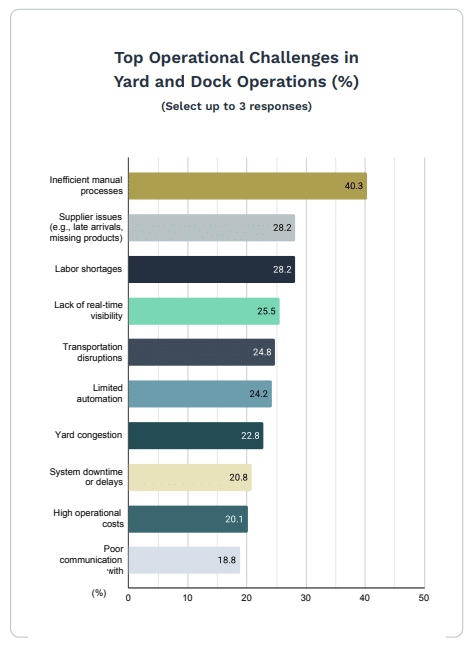
40.3% of respondents rank inefficient manual processes among their top three challenges, up from 35.9% in 2025. That is the wrong direction. Spreadsheets, phone calls and human workarounds between systems still hold many operations together, and every manual touch is a chance for costly human error.
Labor shortages: eased, not solved
28.2% cite labor shortages, down from 32.4%. Don’t mistake this for relief. Companies have normalized chronic scarcity by leaning on overtime, temp workers and tighter schedules. The price is fatigue, inconsistent training and higher unit costs.
Supplier issues: the most important new signal
Another 28.2% name supplier issues, such as late arrivals and missing products, as a top challenge. Combined with transportation disruptions (24.8%), the conclusion is clear: resilience now matters as much as efficiency. Unreliable inbound freight breaks schedules, forces door changes and leaves supervisors guessing how much labor and equipment they need.
The second tier of pain points
- Lack of real-time visibility: 25.5%
- Limited automation: 24.2%
- Yard congestion: 22.8%, down sharply from 34.1% in 2025
- System downtime or delays: 20.8%
- High operational costs: 20.1%
Peak season: people first, technology last
During peak periods, companies still add bodies instead of removing touches:
- 51.0% rely on overtime
- 50.3% hire temporary workers
- 34.2% use technology to increase throughput
This is the playbook that isn’t sustainable. Overtime and temp labor scale your cost, not your capacity.
Late carriers: managed, not prevented
When carriers arrive late, respondents typically:
- Reschedule and notify stakeholders: 49.0%
- Activate contingency plans: 37.6%
- Build in buffer time: 35.6%
- Make manual adjustments: 34.9%
Every one of these is reactive. Our take: the industry’s center of gravity has shifted from yard capacity to network collaboration. Another dashboard won’t fix that. Connected workflows that update carriers, suppliers and dock teams in near real time will.
2- Software Usage and Satisfaction: More Systems, Not More Control

The software stack around the dock and yard keeps growing. But density is not control. Most respondents run some combination of WMS, TMS and YMS, yet many still report fragmentation, limited automation and weak support when disruption hits.
Warehouse Management Systems lead adoption at 62.4%, up from 54.7% in 2025. Transportation Management Systems follow at 41.6%. CRM, ERP and YMS each sit in the low-to-mid 30% range.
The most telling gap is scheduling. Only 18.8% use a Dock Scheduling System, yet 30.9% rank automated dock scheduling among the features they value most. Teams know what they need. Most simply haven’t deployed it yet.
Satisfaction: acceptable is not good enough
53.2% are satisfied or very satisfied with their current dock or yard system. 35.5% are neutral and 11.3% are unsatisfied. That means nearly half of operators are running tools that work, but don’t deliver on their operational ambition.
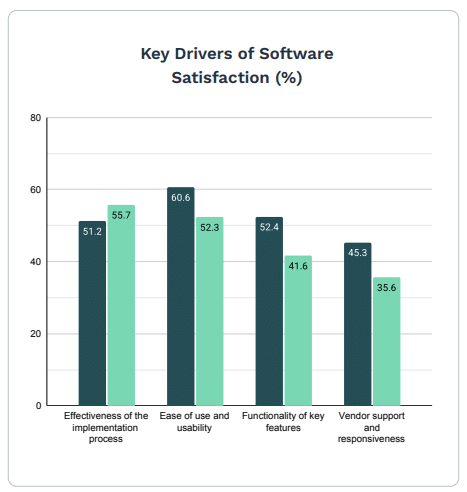
The drivers of satisfaction shifted decisively this year:
- Implementation effectiveness (55.7%) is now the #1 driver, up from 51.2%. This matches what we see in the field: how a system is deployed, adopted and embedded into daily workflows decides whether it delivers ROI or collects dust. Our 10-step guide to implementing a dock scheduling system lays out the approach we use.
- Ease of use (52.3%) remains essential. A system only creates value when it reduces effort during time-critical decisions.
- Functionality of key features (41.6%) still counts, but feature lists don’t win. Features must be deployable, connected and aligned to how your site actually runs.
- Vendor support (35.6%) matters for uptime and fast resolution. Yet the data is clear: a strong implementation and intuitive design reduce how much support you’ll need later.
3- What Buyers Demand From a Dock and Yard Management Solution
Buyers are done with narrow point fixes. They want a platform that solves today’s bottleneck without becoming tomorrow’s integration project.
The features that matter most
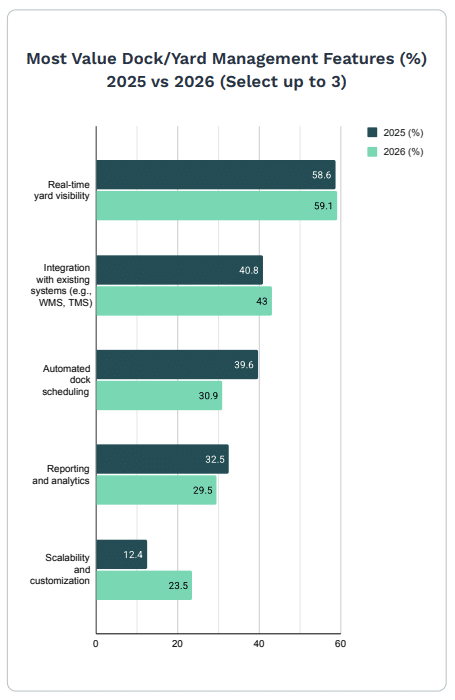
- Real-time yard visibility holds #1 at 59.1% (58.6% in 2025). Without trustworthy data on trailer status, dock activity, appointments and exceptions, no other improvement sticks.
- Integration with existing systems such as WMS and TMS rose to 43.0% (from 40.8%).
- Automated dock scheduling remains a core need at 30.9%.
- Reporting and analytics stands at 29.5%.
- Scalability and customization nearly doubled, from 12.4% to 23.5%, the fastest-rising priority in the survey.
The signal is unmistakable. Automation is still expected, but buyers now judge platforms on whether they fit the wider operating model, adapt to each site and scale without rework.
How buyers choose a vendor
Cost and affordability remain the top criterion at 54.4%, down from 58.0% in 2025. Below that, the field tightens:
- Ability to customize solutions: 42.3%
- Range and quality of features: 40.9%
- Ease of integration with existing systems: 40.3%
- Vendor reputation: 38.3%
- Scalability for future growth: 33.6%
- Level of customer support: 28.9%
Price opens the conversation. It doesn’t close it. Experienced buyers are screening out solutions that shine in a demo but fail on real-site constraints, network rollout or clean integration.
What stalls the decision
- Budget constraints: 43.6%
- Lengthy decision-making processes: 36.2%
- Vendor offerings that don’t match needs: 36.2%
- Lack of internal alignment: 26.2%
Demand isn’t the problem. The path from recognizing the problem to choosing a solution is. Projects stall because teams struggle to define requirements, build consensus and compare vendors on practical terms. That’s exactly why we built a structured RFP toolkit.
4- Sustainability and Driver Experience Are Now Buying Criteria
Sustainability is no longer a nice-to-have. 95.7% of respondents rate it important or extremely important in vendor selection, up from 91.7% in 2025. 71.9% say the same about carbon tracking and emissions optimization. Every minute a truck idles at the gate burns fuel and adds emissions, which is why scheduling is one of the fastest ways to cut them and stay ahead of regulation.

Decision-makers are also looking past emissions. 87.1% rate driver experience as important or extremely important. Wait times, clear communication and smooth yard flow shape your carrier relationships and, in a tight capacity market, whether carriers want your freight at all.
The takeaway: dock and yard software is now judged through a wider performance lens. Efficiency, driver experience and environmental impact, measured in dwell time, detention and emissions.
5- The Road Ahead: High Intent – Low Commitment
Interest in modernization keeps climbing. Readiness hasn’t caught up. Over the next one to two years:
- 72.7% are exploring potential solutions, up from 67.7% in 2025
- 12.9% already have a plan in place, down from 19.4%
- 9.4% are unsure
- 5.0% have no plans to adopt automation
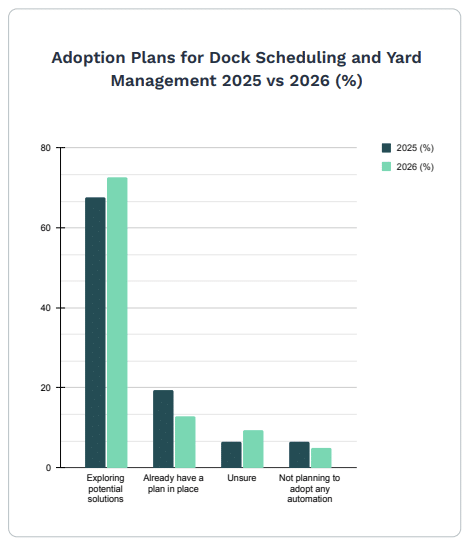
That is a widening gap between intent and execution, and it tracks directly with the budget pressure and long decision cycles above. Here’s what we tell every operator we work with: the organizations that close this gap first will build a compounding operational advantage. Those that wait will spend the next few years catching up.
6- Five Expert Recommendations for 2026
Visibility alone doesn’t remove the daily grind of rescheduling, reassigning doors, updating stakeholders and reconciling data across systems. The next competitive edge in dock and yard management comes from cutting collaboration costs: connecting visibility to execution, and execution to decision support. Based on this year’s data and two decades of deployments, here is what C3 Solutions’ experts recommend.
1 Align internally before you buy
Long decision cycles (36.2%) and poor internal alignment (26.2%) kill more projects than bad software. Before you talk to a single vendor, get operations, IT, procurement and finance to agree on the problem, the requirements and how success will be measured.
2 Treat integration as a first-class requirement
Integration is not a phase-two task. Validate how a new system connects to your WMS, TMS and ERP before you sign. A platform that can’t share data cleanly will create the very manual work you’re trying to eliminate.
3 Make implementation your competitive advantage
Implementation is now the #1 driver of satisfaction. Demand a concrete deployment plan, a training approach and adoption milestones from every vendor. Choose a partner with proven implementation depth and clear service level commitments.
4 Select vendors on operational criteria, not price alone
Score every vendor on site fit, network scalability, integration and customization, alongside cost. A structured questionnaire turns a subjective demo comparison into an objective decision.
5 Make driver experience an operational KPI
With 87.1% of leaders calling it important, driver experience belongs on your dashboard. Track driver wait times, dwell time and detention with the same rigor as throughput and labor cost.
Run High-Performance Operations With C3 Solutions
Dock and yard management remains a critical control point in the supply chain, but the challenge has changed. Manual work is still too prevalent. The bigger story now includes supplier variability, transportation disruption, implementation quality and integration discipline. Compared with 2025, the conversation has moved beyond congestion and toward coordinated resilience.
Most organizations are exploring solutions, care about sustainability and see visibility and integration as essential. Yet most are still early in the journey. The next phase of this market will be defined by execution, not interest.
Operators that sequence modernization carefully, starting with connected workflows and a credible implementation plan, will turn intent into measurable results. That is exactly what C3 Solutions has delivered for more than 20 years, across 1,200 sites and 160,000 active users worldwide. If you’re ready to move from exploring to executing, we’re ready to show you how.

Other articles you might like
-

Detention Pay Explained: Causes, Costs and Solutions
By Hamza Lguirri • October 9, 2026What Is Detention Pay? “Detention pay” is what drivers get when they’re stuck at a warehouse or loading dock longer… -

How to Integrate Yard Management with WMS and TMS
By Hamza Lguirri • October 9, 2026In today’s complex supply chain environment, silos between yard management, warehouse operations, and transportation systems can create inefficiencies that slow… -
Improving Dock Scheduling in Retail Logistics
By Hamza Lguirri • October 9, 2026Retailers often work on razor-thin margins, and the shareholders highly appreciate money saved from anywhere as it adds to the…
Leave a comment